

Ending the year with action – and hope
Yet another COP has ended. It’s tempting to say yet again nothing has been achieved - but maybe not this time? A breakaway group of 80+ nations, dissatisfied that the official final statement contained no mention of fossil fuels and phasing them out, came up with an alternative.
They committed to working towards a “roadmap” that “calls for efforts” to transition away from the unmentionables – gas, oil, coal. Supporting countries include Australia, the UK, most European nations and numerous island states.
In April next year Colombia and the Netherlands will host the first International Conference for the phase-Out of Fossil Fuels.
But we won’t be there! Our minister for climate change Simon Watts didn’t sign us up.
Is this surprising, given this government’s demolition or downgrading of key aspects of our emissions reductions policies? The Zero Carbon Act has been eviscerated, the hardworking body of experts brought together in the Climate Change Commission has had their advisory role sidelined, public consultation has been restricted.
We should be alarmed. These actions bring us close to the denialist camp of Trump followers in the US. They also mirror their autocratic anti-democratic methods of governing.
Are we seeing a gradual division of the world into believers and denialists? What level of disasters will it take for humanity to begin to work together for survival?
Where and how do we start the process of resilience?
Here, at OCD, we’re committed to exploring these questions and discussing some of the answers.
For instance, our first webinar for 2026 examines the challenge of aviation and shipping emissions. This will be on February 12, presented by Robert McLachlan, Distinguished Professor in Applied Mathematics at Massey University. He writes on climate and environment at planetaryecology.org and is a member of the Planetary Limits Academic Network.

Find details for this event here:

To take you into the summer holiday season, we offer you this account of resilience…
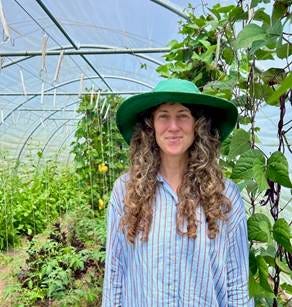
Sarah McFadden, manager Kelmarna Gardens, Ponsonby
Heartwarming stories are rare in this age of impending crisis. We hear the warnings from climate scientists of tipping points - the Amazon forest on the point of becoming a source of emissions rather than sequestering them; the over-heated acidified ocean no longer absorbing the carbon we emit; close to home, the West Antarctic ice sheet is melting and will slowly raise sea levels of our coasts.
But in my neighbourhood the Kelmarna Community Farm is stunningly alive. You can almost hear the plants growing: long rows of vegetables, beds of flowers – snapdragons, calendulas, salvia, alstroemeria – cultivated to keep the insect population strong for pollination.
A market garden area grows vegetables under a tunnel house for the on-site farm shop, veggie box subscriptions and some restaurants and cafes. Various trees in the food forest provide a range of fruit including bananas, babaco, cherry guavas, persimmon, pears and peaches. Hens free range over a small paddock and half a dozen sheep graze nearby.
Spanning just over 1.7 hectares, this organic garden has nourished the souls and bodies of its Ponsonby neighbourhood for 40 years.
Sustainable food is my thing, says Sarah McFadden who, along with a team of seven, manages the farm. It’s a much used term and I ask her what it means.
Sustainability, she says, is shorthand for how we live on the planet, for our connection with the whenua and all the life forms we share it with.
Climate change, she’s noticed, has brought heavier rainfall, less predictability in the weather and winters that are not cold enough to kill off the germs.
“Survival day to day can be a challenge,” she says, “but we’re consulting with the community about what Kelmarna could be in 20 years.”
That long term view is fed by her positive sense of hope.
“So many things can seem out of control but we can all make a difference, we all have a role to play by contributing to something local.”
Sarah’s own journey began with management and commerce and then a paper on environment and sociology took her into the relationship of health, environment and food. Since that time her working life has been dedicated to community agricultural projects, at first in the UK , then back in Christchurch before joining Kelmarna.
Food, she says, is a tangible way to get people to think about the environment. This is especially important for cities where there’s little or no contact with where and how food is produced. But cities are also rich in small spaces where things can grow and Sarah cites “agrihoods” where communities combine residential living with small scale agriculture. https://www.abc.net.au/listen/programs/lifematters/agrihoods/105875986
People are inspired, Sarah observes, and as they learn they take their knowledge and their energy into the community.
Kelmarna’s integration into the neighbourhood can perhaps be measured by the educational projects it runs for schools, the workshops for home gardeners and its therapeutic programmes for people in need. Meanwhile the weeding, planting, horticultural work is carried on by 500 community volunteers who give 9000 hours of work each year.
Sustainable? The odds are positive.
Pat Baskett
Ngā mihi o te tau hou